
"I've been wearing gel nails for years — and suddenly my fingertips are flaring up." "It's itchy, red, peeling, and small blisters are showing up."
We've been seeing more and more clients come in with concerns like these.
Wearing gel nails over a long period can lead to gel allergy, hand eczema, or greenies (pseudomonas infection).
Gel itself is a wonderful, convenient option — but when the technique is wrong, or it's pushed too hard for too long, the strain can build up on both the nail plate and the surrounding skin.
In this post, from a nail tech's perspective:
- What is gel allergy?
- Why does it appear out of nowhere?
- What actually causes greenies
- The risk of hand rashes and dark pigmentation
- What matters most for enjoying gel safely
What is gel allergy?
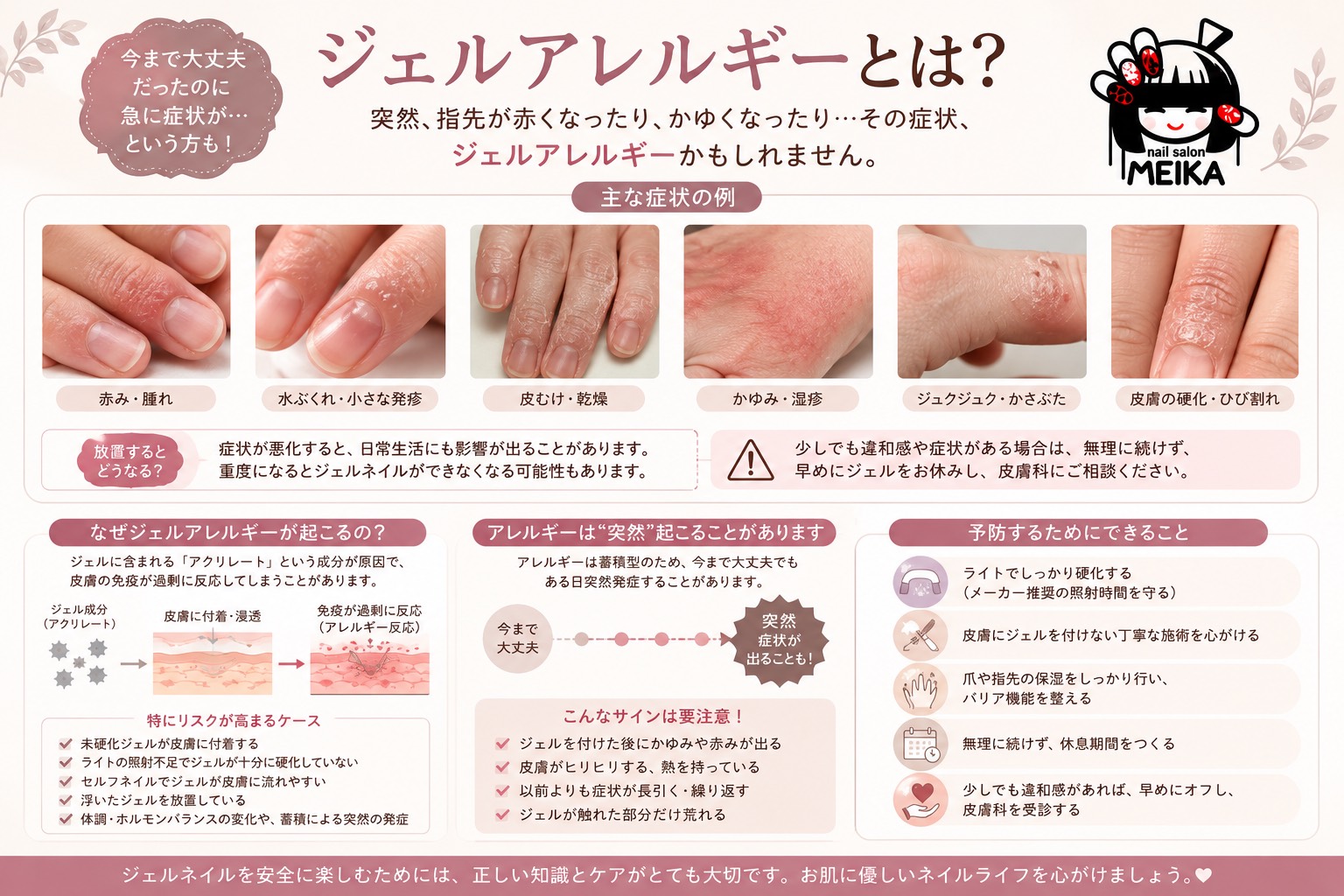
Gel products contain ingredients in the acrylate family.
Cured properly under a UV/LED lamp, they're safe to wear. But if curing is insufficient or the product is applied incorrectly, uncured gel can touch the skin and trigger an allergic reaction.
Common symptoms include:
- Itchiness at the fingertips
- Redness
- Eczema-like patches
- Blisters
- Peeling skin
- Swelling
- A burning, warm sensation
Even mild symptoms can escalate if you keep pushing through, and in some cases, the person can no longer wear gel at all going forward.
"I was fine for years and it suddenly started" — this is normal
Gel allergy showing up out of nowhere is not unusual at all.
That's because it's a cumulative type of allergy.
Things like:
- Wearing gel continuously for years
- Uncured gel touching the skin repeatedly
- DIY gel running onto the skin
- Leaving lifted gel in place
- Insufficient curing time
…all stack up, and one day the reaction simply surfaces.
DIY work and low-cost salons carry a higher risk, because:
- Under-curing
- Lack of product knowledge
- Poor prep work
- Gel touching the surrounding skin
…all tend to happen more often.
Hand rashes and pigmentation from uncured gel and acetone
Recent research has also documented skin damage caused by uncured gel and acetone.
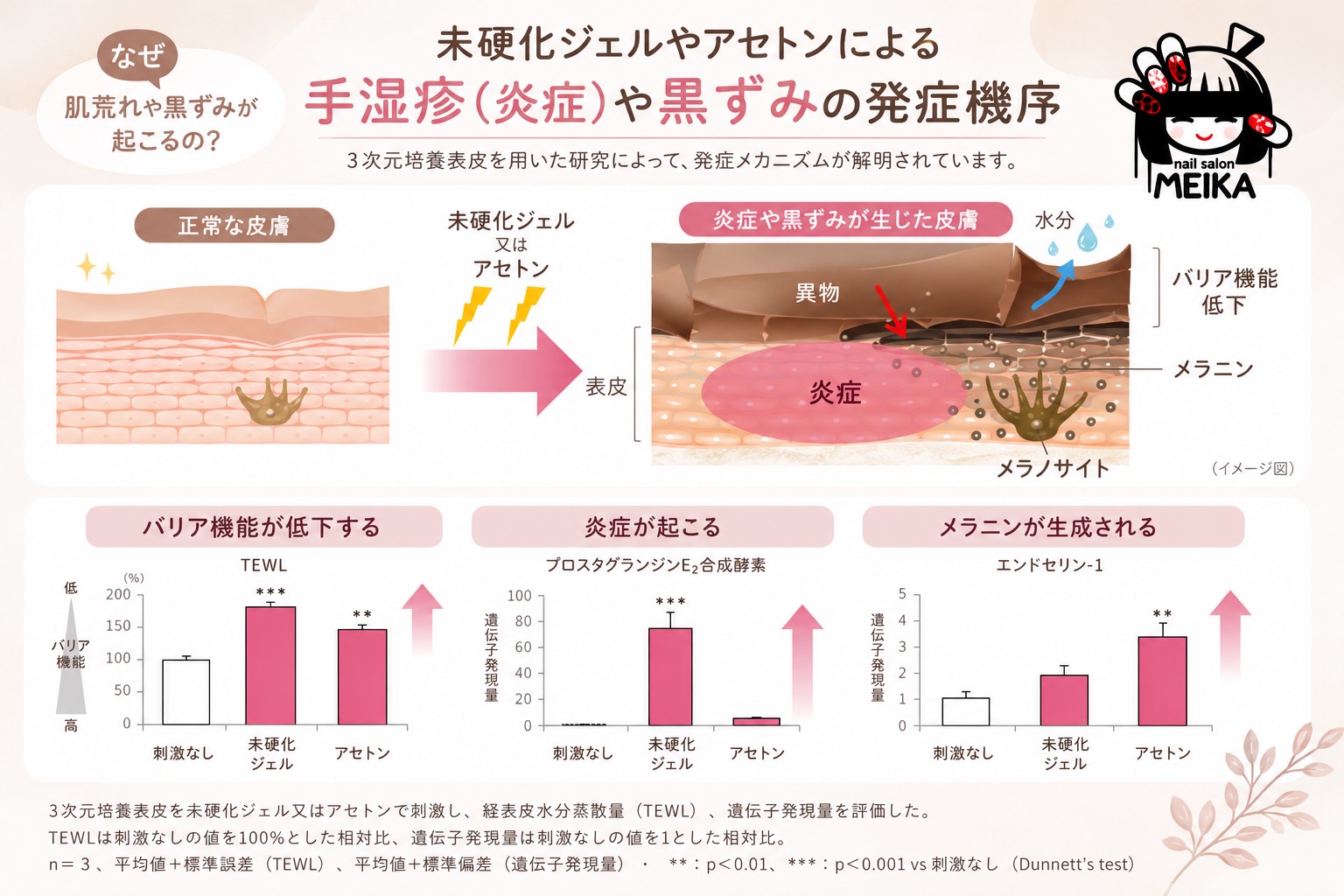
Studies suggest that uncured gel and acetone can contribute to:
- Weakened skin barrier
- Dryness
- Inflammation
- Hand eczema
- Dark pigmentation
Acetone in particular has a strong degreasing effect — it strips both oil and water from the skin, so frequent soak-offs can make hand rashes worse.
There's also evidence that uncured gel touching the skin can increase inflammatory signals, which may stimulate melanin production and lead to dark spots over time.
What are greenies?
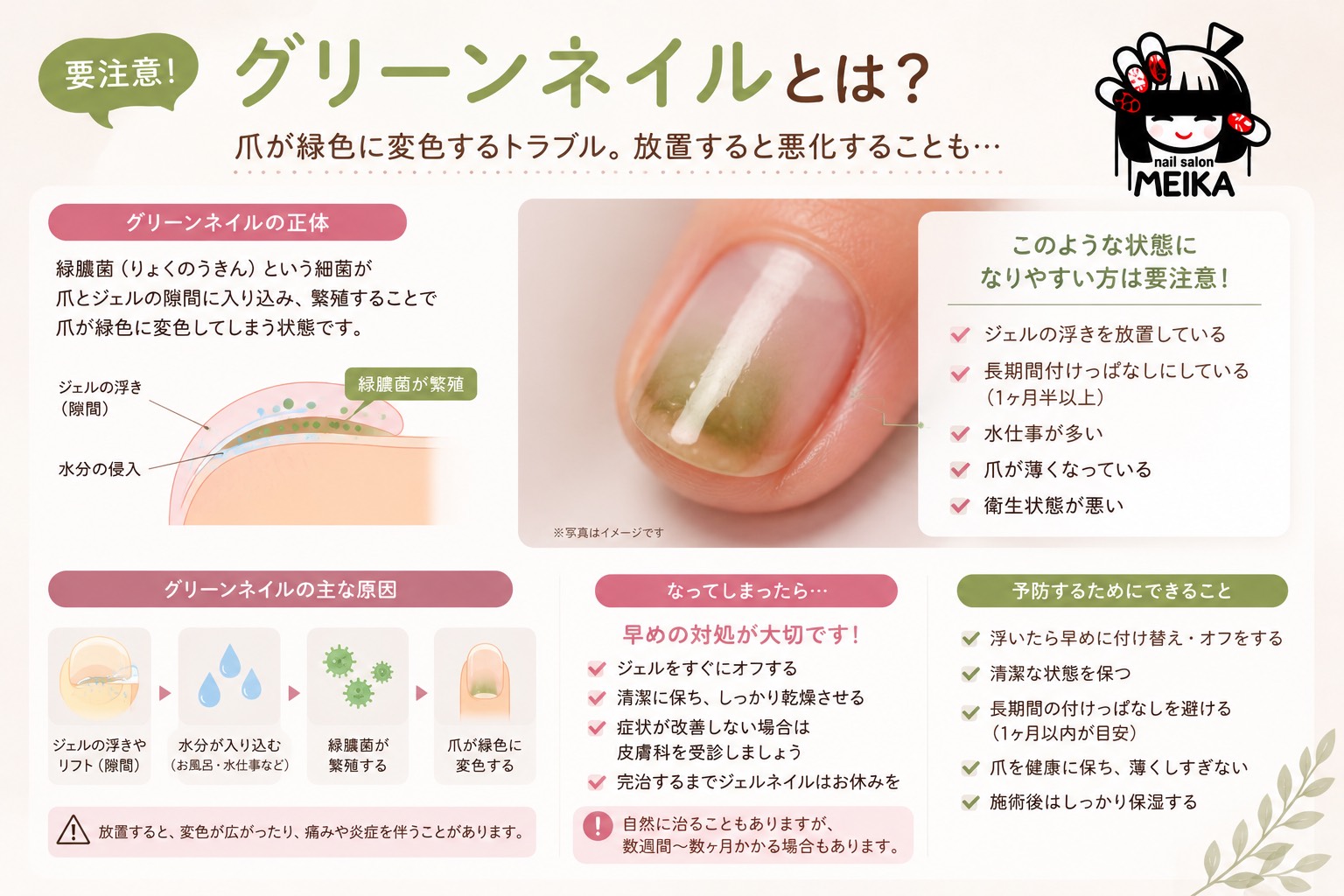
Greenies are a condition where the nail discolours to a greenish shade.
Common causes:
- Lifted gel
- Water getting underneath
- Unsanitary conditions
- Wearing the same set too long
A gap under lifted gel traps moisture and bacteria, and pseudomonas can grow there.
Risk is higher when:
- A set is worn longer than ~1.5 months
- Gel is reapplied over already-lifted areas
- The natural nail is already thinned
If greenies develop, you may have to pause gel entirely for a while.
Why nails get thinner
Many people assume "gel = thin nails," but the bigger cause is usually how it's removed or filed.
The riskiest patterns:
- Full acetone soak-off every visit
- Excessive sanding
- Peeling gel off forcibly
- E-filing into the natural nail
Once the nail thins out:
- Gel lifts more easily
- Nails snap
- It becomes painful
- Greenies are easier to develop
…which spirals into a vicious cycle.
How to keep enjoying gel safely
1. Don't push through symptoms
If you notice itchiness, redness, or anything that feels off, stop wearing gel for a while rather than forcing it.
2. Choose a salon with real product knowledge
Nail work isn't only technique — it also depends on:
- Hygiene practices
- Product knowledge
- An understanding of the chemistry
- The ability to read each nail's condition
Picking purely on price can end up costing your nails and your skin more.
3. Don't leave lifting unattended
Lifted gel is dangerous because moisture and bacteria get underneath. If something feels off, get it filled or removed sooner rather than later.
4. Moisturise consistently
Nail oil and hand cream play a real role in keeping the skin barrier intact around the nail.
Final thoughts
Done right and looked after, gel nails are something you can enjoy for years.
But the following can put serious strain on the nail and skin:
- Forcing continuation through symptoms
- Insufficient knowledge
- Low-quality technique
- Improper removal
If you're noticing:
- Itchiness
- Redness
- Nail discolouration
- Blisters
- Hand rashes
…take a break from gel, and consider seeing a dermatologist if needed.
At Nail Salon MEIKA, we adjust each appointment around the client's individual nail and skin condition, with the goal of keeping the strain as low as possible.
"My gel hasn't been lasting as long lately." "My skin around the nails is starting to flare up." "I'm not sure if gel is still working for me."
If any of this sounds familiar, please feel free to talk it through with us.